

Sell Development Land in Washington
Own a larger parcel, adjoining properties, or land that may support new development? Start with the property details you already have.
Goan Properties Limited reviews Washington subdivision sites, infill parcels, multifamily and mixed-use land, commercial redevelopment property, and assemblages from an acquisition perspective.
About this resource
Prepared by Goan Properties Limited from the perspective of evaluating and acquiring Washington development land. This resource explains factors Goan considers when reviewing subdivision sites, infill parcels, multifamily and mixed-use land, commercial redevelopment property, and assemblages. Zoning, entitlement, infrastructure, feasibility, and valuation conclusions remain property-specific and should be verified using current jurisdictional information and appropriate professional review where necessary.
Start with an address or parcel number, county and email. No plans or studies are required to begin.
An initial review may identify questions that need further investigation; it does not establish buildability or guarantee an offer.
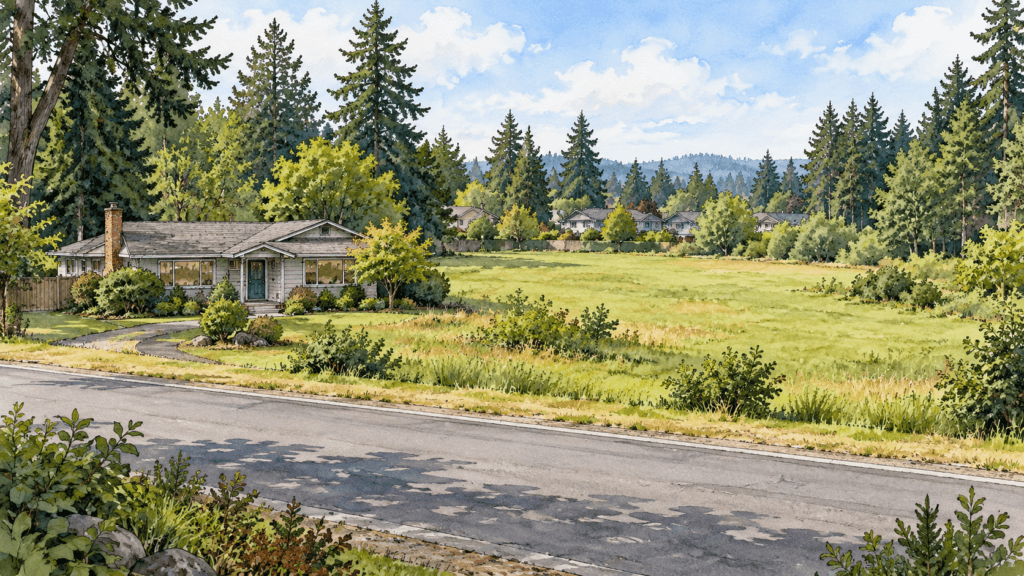
Which Situation Matches Your Land?
A larger vacant parcel
You want to understand the questions a buyer may ask about subdivision or other development potential. Start with what you know; a finished plan is not required.
Adjoining properties
You own or represent one or more neighboring parcels. See what to share about an assemblage.
Apartment or mixed-use potential
Your questions concern density, use or redevelopment. Explore multifamily land or commercial land.
Existing buildings or prior plans
An older building, earlier concept or stalled proposal may be part of the story. Tell us what exists and what has changed. For smaller urban sites, see infill lots.
How Our Development Land Review Works
1. Share the basics
Use the short parcel-review form. Enter an address or parcel number, county and email. Phone and additional notes are optional. If you have several parcels, list them in the notes.
2. Clarify the property
We may follow up about ownership, adjoining parcels, existing buildings, access, utilities or prior plans. We distinguish what you report from information that still needs verification.
3. Discuss the next step
The next step may be a request for missing information, further investigation, a purchase discussion, or a decision that the property is not a fit. A review does not guarantee an offer or closing.
If purchase discussions progress, price, due diligence and closing terms depend on the property and an agreed contract.
A Fictional Development Land Review Example
An example of how owner statements, unresolved questions and a next step can be separated.
Fictional example: No actual parcel or official record was reviewed. This illustration is not a promised report format or result for every enquiry.
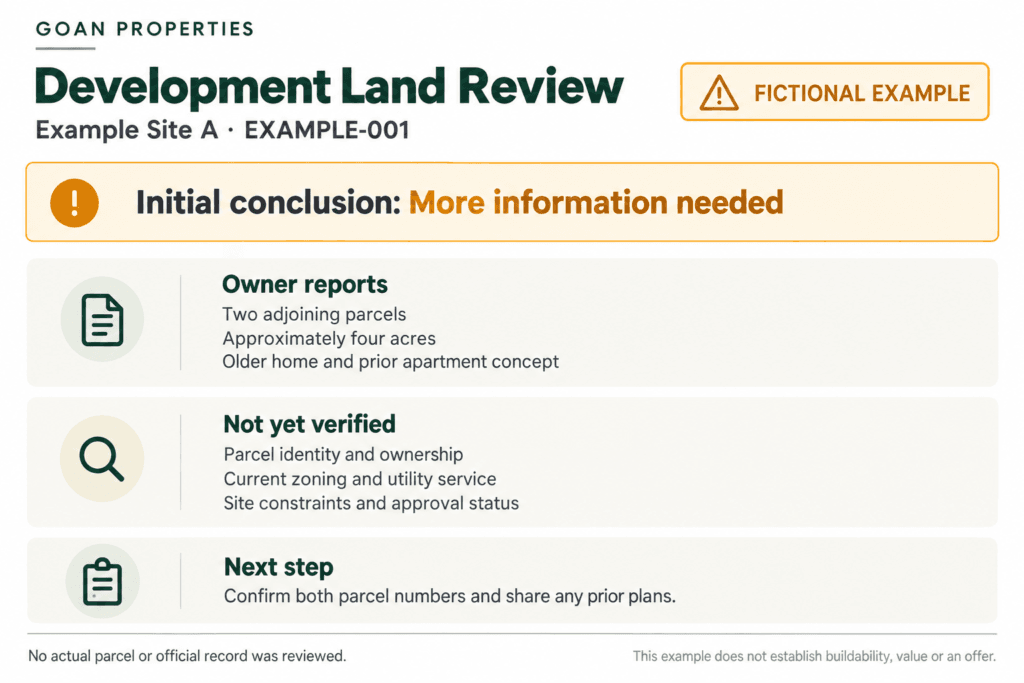
Owner reports
- Two adjoining parcels.
- Approximately four acres.
- An older home and a prior apartment concept.
Not yet verified
- Parcel identity and ownership.
- Current zoning and utility service.
- Site constraints and approval status.
Next step: Confirm both parcel numbers and share any prior plans.
Development Land Requires More Than a Simple Price Opinion
A parcel may look promising because of size, location, zoning, or nearby construction activity.
However, development value also depends on access, utilities, stormwater, slope, wetlands, setbacks, road improvements, title, feasibility, and what the city or county may require before anything can be built.
Zoning creates the starting point
Residential, commercial, mixed-use, multifamily, and urban growth zoning can each support different development paths.
Feasibility controls reality
A parcel may have potential, but utilities, critical areas, access, or infrastructure costs can change the actual value.
Entitlements take time
Subdivisions, short plats, site plans, permits, and predevelopment review can require time before a buyer can fully commit.
How to Sell Development Land in Washington
Selling development land is different from selling a conventional house or a simple vacant lot. Buyers are usually underwriting what the site can realistically support, what remains uncertain, how much capital is required before construction, and how long it may take to reach a usable approval or permit stage.
Types of Development Land We Review
- Subdividable land and potential short plat sites.
- Infill lots in established city neighborhoods.
- Multifamily-zoned parcels and small apartment development sites.
- Mixed-use land near commercial corridors.
- Commercial redevelopment parcels and underused land.
- Large residential lots with extra land or teardown potential.
- Parcels with zoning upside, entitlement questions, or uncertain highest use.
Why Owners Contact a Direct Development Buyer
Some owners know their land may be worth more than a standard lot, but they do not want to spend money on engineers, planning consultants, surveys, permits, or months of feasibility work before knowing whether a transaction is realistic.
A direct review can help clarify whether the property is a simple land sale, an entitlement opportunity, an option candidate, or a parcel that needs too much work for the current market.
Theoretical Zoning Capacity vs. Realistic Development Yield
Sellers sometimes hear that zoning allows a certain number of homes, apartments, lots, or square feet and then assume the land should be valued from that maximum. Development buyers usually need a more conservative answer: what can reasonably fit after site constraints and required improvements are considered?
- Setbacks, lot coverage, height, and required open space.
- Driveways, fire access, circulation, and emergency access.
- Stormwater facilities, drainage, and utility corridors.
- Wetlands, buffers, steep slopes, streams, and other critical areas.
- Trees, grading, retaining walls, and difficult topography.
- Parking or loading requirements where applicable.
- Road dedication, frontage work, sidewalks, or other infrastructure.
- Marketable unit configuration and construction efficiency.
Why This Difference Matters to Land Value
A buyer cannot normally pay for units, lots, or floor area that cannot be delivered economically. Therefore, the supportable land value usually reflects realistic project yield rather than a simple maximum-density calculation.
This is also why a smaller parcel with straightforward access, utilities, and site conditions can sometimes compete well with a larger parcel that has more severe constraints or expensive infrastructure.
What Affects Value When You Sell Development Land in Washington?
Development land is usually priced around potential, risk, and cost. The more uncertainty a buyer must solve after signing, the more that uncertainty can affect price, timing, and deal structure.
Zoning and density
Allowed use, lot size, density, setbacks, height, parking, and overlay rules can shape the highest practical use.
Utilities and frontage
Sewer, water, stormwater, power, frontage improvements, sidewalks, and road standards can materially affect project cost.
Critical areas
Wetlands, buffers, steep slopes, drainage, floodplain, and habitat constraints can reduce usable land area.
Access and circulation
Driveway location, easements, shared access, road width, and emergency access can affect whether the site works.
Site shape and topography
Narrow lots, irregular shapes, slope, retaining needs, and grading costs can change what can be built.
Entitlement timeline
Short plats, boundary adjustments, rezoning, site plans, and permit reviews can affect how quickly the land can become usable.
How Developers Often Think About Supportable Land Value
Development land is frequently analyzed with a residual approach. Instead of asking only what nearby raw land sold for, a buyer may estimate the value of the completed project and work backward through the costs and risks required to create it.
Project revenue
Expected lot, home, unit, commercial, or finished-project value based on a realistic development concept and market assumptions.
Horizontal and vertical costs
Sitework, utilities, roads, grading, stormwater, retaining, demolition, construction, frontage work, and other project costs.
Soft costs and carrying risk
Design, engineering, permits, consultants, financing, taxes, insurance, entitlement duration, sales costs, contingency, and required return.
Raw, Feasibility-Stage, and Entitled Development Land
Development land can reach the market at very different stages. The more uncertainty that has been resolved, the easier it may be for a buyer to underwrite the property—but advancing a site also requires time, professional work, and capital from the owner.
Raw or unentitled
Development potential is mostly conceptual. Zoning may be known, but access, utilities, site constraints, yield, and approvals may still require significant investigation.
Feasibility-stage
Some planning, survey, engineering, utility, critical-area, or site work has been completed, but major approvals may still be outstanding.
Entitlement in process
Applications, short plats, site plans, rezones, or other approvals may be underway. A buyer needs to understand what has been submitted, what remains open, and whether approvals transfer.
Entitled or near-ready
Important development rights or approvals have been secured, reducing some uncertainty. Permit, utility, financing, construction, or market risk may still remain.
Entitlement can improve clarity, but it does not automatically mean every owner should carry the project further before selling. The right stopping point depends on cost, time, risk tolerance, market conditions, and how much additional value the next stage is likely to create.
When an Option or Due Diligence Period May Make Sense
Some development land cannot be valued properly in a few days because the real value depends on approvals, engineering, planning feedback, utility capacity, or entitlement risk.
In those cases, a flexible structure can sometimes help both sides. The owner may get a serious buyer working on the property, while the buyer gets time to confirm whether the site can support the intended use.
However, sellers should compare the entire contract rather than focusing on price alone.
Terms to Compare Before You Commit
Common Owner Situations
- The land may be subdividable, but the owner has not verified it.
- The parcel has zoning upside but unclear development cost.
- The owner inherited land and does not want to manage entitlement work.
- The site has an older structure that may be a teardown.
- The land is vacant, underused, or producing little income.
- The property has access, utility, or critical area questions.
- The owner wants to avoid listing publicly while feasibility is uncertain.
Reviewing Adjoining Parcels
You can share one parcel or several adjoining properties. Tell us which properties you own or represent and whether other owners are participating. If you do not know, say so.
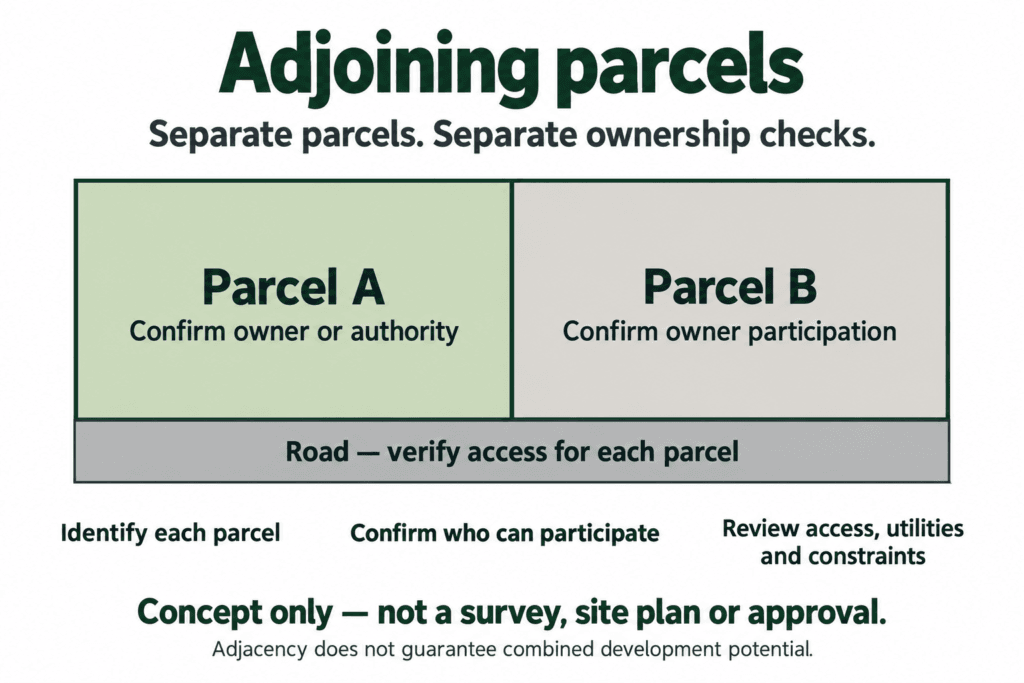
Identify each parcel separately. Confirm the owner or your authority for Parcel A, and owner participation for Parcel B. A road beside the land does not establish legal access: verify access for each parcel, then review utilities and constraints. Adjacency does not guarantee combined development potential.
Assemblage Can Change Development Value
Some development opportunities only become efficient when two or more neighboring parcels are analyzed together. Combining property can improve frontage, site depth, circulation, utility layout, parking, density efficiency, or the ability to place buildings on the site.
An assemblage does not automatically make every parcel more valuable. The buyer still has to consider ownership coordination, closing risk, existing improvements, tenant or lease issues, site constraints, and whether the combined project supports the total acquisition cost.
Infrastructure Can Be a Major Land-Value Variable
"Utilities nearby" and "utilities economically available to the project" are not always the same thing. Development sites may require substantial off-site or frontage work before the land can support construction.
- Sewer or water extensions, upgrades, or connection work.
- Stormwater detention, treatment, conveyance, or infiltration facilities.
- Sidewalk, curb, gutter, frontage, or road improvements.
- Road dedication, access improvements, or emergency circulation.
- Power relocation, transformer work, or utility coordination.
- Grading, retaining, demolition, clearing, or site preparation.
Where We Review Development Land in Washington
Owners who want to sell development land in Washington may have very different sites and market conditions. We review development-oriented property across the state, especially parcels where location, zoning, and future use may create more value than a standard vacant land sale.
Urban infill
Lots in or near Seattle, Tacoma, Everett, Bellevue, Renton, Kent, Lynnwood, Edmonds, and other built-out markets.
Suburban growth areas
Parcels near expanding neighborhoods, commercial corridors, utility service areas, and future housing demand.
County-edge opportunities
Larger parcels where value depends on access, zoning, infrastructure, entitlement timing, and realistic exit strategy.
What to Send When You Are Selling Development Land
You do not need a complete engineering package before contacting us. Start with the parcel number, county, address, ownership information, and anything you know about zoning, utilities, access, prior development discussions, or current entitlement status.
- Parcel numbers and ownership information.
- Survey, boundary, or legal-description material if available.
- Title report or known easement information.
- Zoning, preapplication, or planning correspondence.
- Concept plans, yield studies, or prior development proposals.
- Wetland, critical-area, geotechnical, or environmental reports.
- Utility availability letters or service correspondence.
- Subdivision, short plat, site-plan, or permit applications.
- Civil, drainage, grading, or stormwater concepts.
- Existing leases, tenant information, or improvement details.
If you have only the parcel number, that is still enough to start. Documentation helps reduce uncertainty, but owners should not assume they must spend money creating studies solely to request an initial land review.
We Review Both Simple and Complicated Sites
Development parcels are rarely perfect. We can still review land with slope, access issues, utility uncertainty, older buildings, title questions, tax problems, zoning confusion, or entitlement risk.
Helpful Washington Land Resources
These related pages may help if your property is commercial, vacant, inherited, or part of a broader Washington land sale decision.
Sell Commercial Land in Washington
For commercial, mixed-use, corridor, or redevelopment-oriented property.
Sell Infill Lot in Washington
For smaller urban lots, side parcels, and established-neighborhood development sites.
Sell Multifamily Land in Washington
For land that may support apartments, townhomes, stacked housing, or other multifamily concepts.
Washington Land Feasibility Guide
Understand access, utilities, site constraints, yield questions, and early-stage feasibility.
Washington Land Entitlement Guide
For subdivision, site-plan, zoning, permit, and approval-stage questions.
Washington Land Zoning Guide
Review how zoning, density, dimensions, and allowed use can shape development potential.
Washington Utility Guide
For water, sewer, power, stormwater, and service-cost considerations.
Washington Critical Areas Guide
For wetlands, streams, buffers, slopes, habitat, and other mapped site constraints.
Washington Land Directory
Browse Goan's city, county, seller-situation, and technical land-resource pages.
Frequently Asked Questions About Selling Development Land
Development sites are highly property-specific. These answers provide a practical starting point for owners deciding how to sell development land in Washington.
How do I sell development land in Washington?
Start by identifying the correct parcel, current zoning, known access and utility conditions, and any existing feasibility or entitlement work. Then decide whether to sell as-is, advance the site further, list it broadly, or compare a direct development-land buyer. Price and contract terms should both be evaluated.
Can I sell development land in Washington without getting permits first?
Yes. Many owners sell before permits are approved. Permit and entitlement status can affect value and contract structure, but you do not need to complete the entire approval process before contacting Goan Properties Limited.
Is entitled development land always worth more?
Not always. Entitlements can reduce uncertainty and may improve buyer confidence, but they also require time and money. The net benefit depends on the approvals obtained, remaining risks, market demand, infrastructure costs, and whether the entitlement fits a buyer's project.
How do developers determine what they can pay for land?
Many developers work backward from expected project revenue and subtract construction, site work, infrastructure, soft costs, financing, carrying costs, sales costs, contingency, and required return. The amount left can help define supportable land value.
What is residual land value?
Residual land value is the amount a project can support for land after expected development revenue is reduced by the costs, risks, and required return needed to complete the project. It is one reason zoning potential alone does not determine land price.
What if zoning allows more units than the site can realistically support?
That is common. Setbacks, access, stormwater, utilities, critical areas, trees, topography, parking, circulation, frontage work, and site geometry can reduce realistic yield below the theoretical zoning maximum.
How long can development-land due diligence take?
It varies widely. A straightforward site may be reviewed relatively quickly, while a property that depends on utility confirmation, planning feedback, surveys, engineering, environmental work, or entitlement questions may require a longer feasibility period.
Can adjacent parcels be sold together as a development assemblage?
Yes. Combining neighboring parcels can sometimes improve frontage, access, circulation, site geometry, project scale, or development yield. The combined economics still need to support the total acquisition and development cost.
Can I sell development land with wetlands, steep slopes, or other critical areas?
Yes. Development land with constraints can still be reviewed. The key question is how the critical areas, buffers, topography, drainage, access, and required studies affect usable land area, development cost, and buyer risk.
What documents should I provide when selling development land?
Send the parcel number first. If available, surveys, title reports, planning correspondence, utility information, concept plans, wetland or geotechnical reports, civil work, permit applications, and prior development studies can help reduce uncertainty.
Can an option agreement make sense for development land?
Sometimes. An option can give a buyer time to investigate or pursue approvals while giving the seller defined terms for the property. The option price, duration, extension rights, consideration, access rights, and closing conditions should be understood before signing.
Do you review development land with older buildings or teardown potential?
Yes. Older structures, demolition cost, tenants, leases, contamination concerns, utility conditions, and redevelopment potential can all be part of the development-land review.
Want Us to Review Your Development Land?
Send us the parcel number, county, property address, zoning if known, and any details about utilities, access, subdivision potential, prior city feedback, or development discussions.